At 8:59 AM on July 13th, RPD's automated wallet monitoring system fired its first alert on $CASHCAT — a new meme token on Robinhood Chain (Chain ID #4663). The token had just been deployed. No liquidity pool had been created yet. The scan still returned a CRITICAL flag.
Token: Cash Cat ($CASHCAT) · Robinhood Chain
Risk Score: 70 / 100 — CRITICAL
-
🔴 NO LIQUIDITY FOUND No active trading pool detected at time of scan. Token cannot be reliably traded — or exited.
-
🔴 CONTRACT SOURCE NOT VERIFIED — CODE IS HIDDEN The contract at 0x020bfc65...291018b4 has not been verified on the block explorer. No one outside the deployer can read what the contract does.
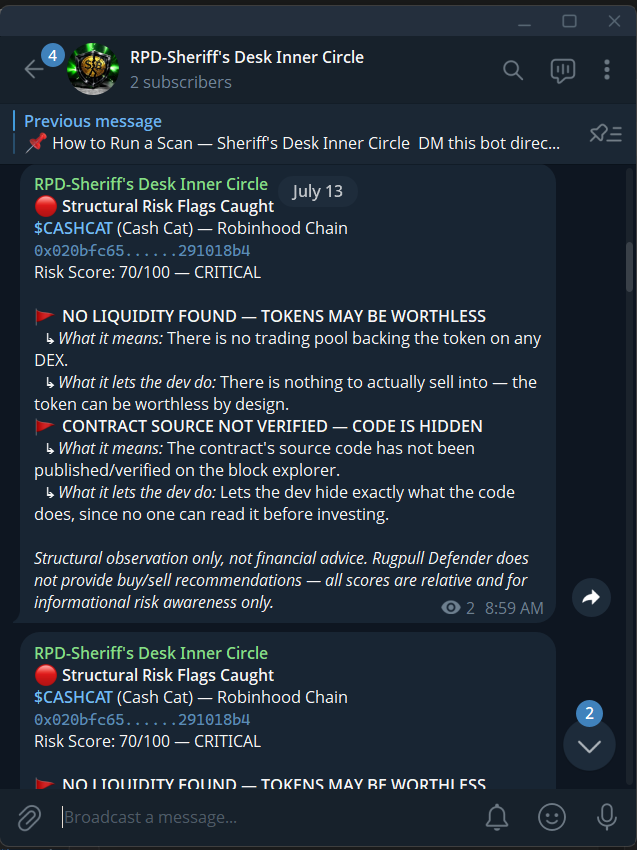
Robinhood Chain (Chain ID #4663) launched in 2025. Most token scanners — TokenSniffer, BWB Global, and others — return blank results or errors when queried against it. For anyone buying $CASHCAT on July 13th, the implicit signal from those tools was: "nothing flagged it." RPD covered Robinhood Chain from launch. When the scan fired, the engine had full visibility. The rest of the market was scanning blind.
At 9:50 AM — exactly 51 minutes after the first alert — RPD scanned again. The liquidity pool had been created. The score dropped from 70 to 10.4 because the "no liquidity" flag cleared. But the alert that fired next was more important than any score.
Token: Cash Cat ($CASHCAT) · Robinhood Chain
Risk Score: 10.4 / 100 — LOW
-
🔴 LP TOKENS NOT LOCKED — LIQUIDITY CAN BE PULLED AT ANY TIME "Lets the dev pull all the trading liquidity out instantly, crashing the price to zero (a 'rug pull')."
-
🟡 CONTRACT SOURCE NOT VERIFIED — CODE IS HIDDEN Still unverified. Contract mechanics remain unknown to anyone outside the deployer.
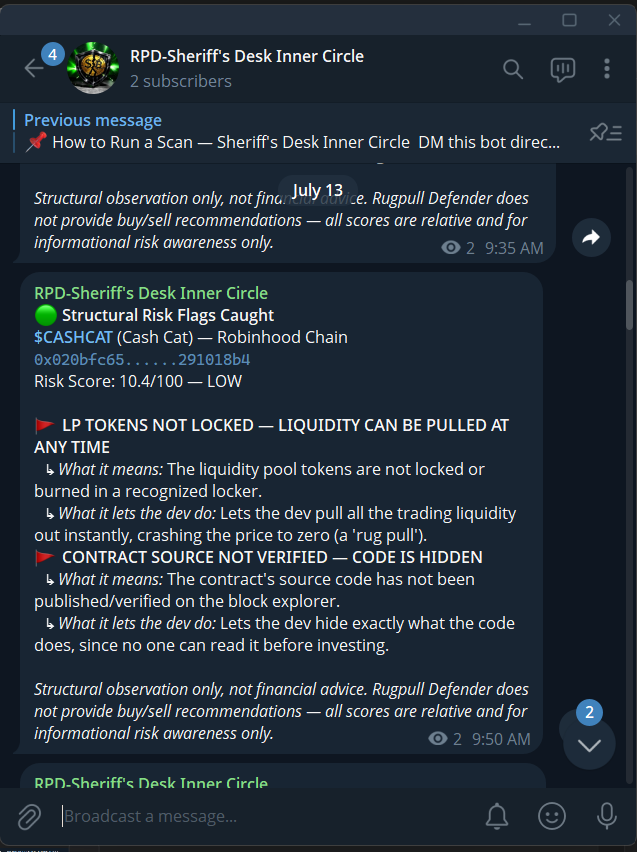
The score went from 70 to 10.4 — not because the token got safer, but because the "no liquidity" flag cleared once the pool appeared. The aggregate score improved. The structural risk did not. The LP was live, active, and completely unprotected. RPD said it in plain language: "Lets the dev pull all the trading liquidity out instantly, crashing the price to zero."
That sentence was written on July 13th at 9:50 AM. It executed on July 17th.
Between July 13th and July 17th, $CASHCAT pumped to a peak market cap of approximately $240 million. The FOMO app — a social trading platform — showed thousands of holders posting positions, calling bottoms, and encouraging each other. The psychological environment was a closed loop of confirmation bias.
"Conviction remains the same and I will go down with the ship."
"Did yall forget Vlad followed the Twitter"
"$cashcat and $rob barbell"
"Cat runner is inevitable. Robinhood needs a meme — betting CASHCAT is the runner."
This is not mockery. These are the words of real people making real financial decisions in a community built around shared conviction. The same psychology that built communities around legitimate projects was being activated here — deliberately, against an unprotected liquidity pool. The degen culture — the "diamond hands" identity, the honor of holding through pain — became the mechanism of extraction. While people competed to show the most conviction, the deployer was quietly calculating something very different.
On July 17th, the deployer began withdrawing liquidity from the Uniswap V3 pool on Robinhood Chain. Not all at once — that triggers immediate alarm. Gradually. Patiently. While the community bought every dip. RPD captured each state in real time.

At 6.1 WETH, the pool backing 30,000+ holders contained approximately $23,000. The top holder on the FOMO app alone showed a position worth $218,576 — a position that required over $218,000 in buy pressure to exit. There was $23,000 in the entire pool.
The FOMO app — the social trading platform where CASHCAT had its community — showed 6,578 holders. These are the visible ones: the ones posting, calling bottoms, encouraging each other. On-chain data showed approximately 30,000 total holders. The other ~24,000 were silent — watching their wallets, hoping.
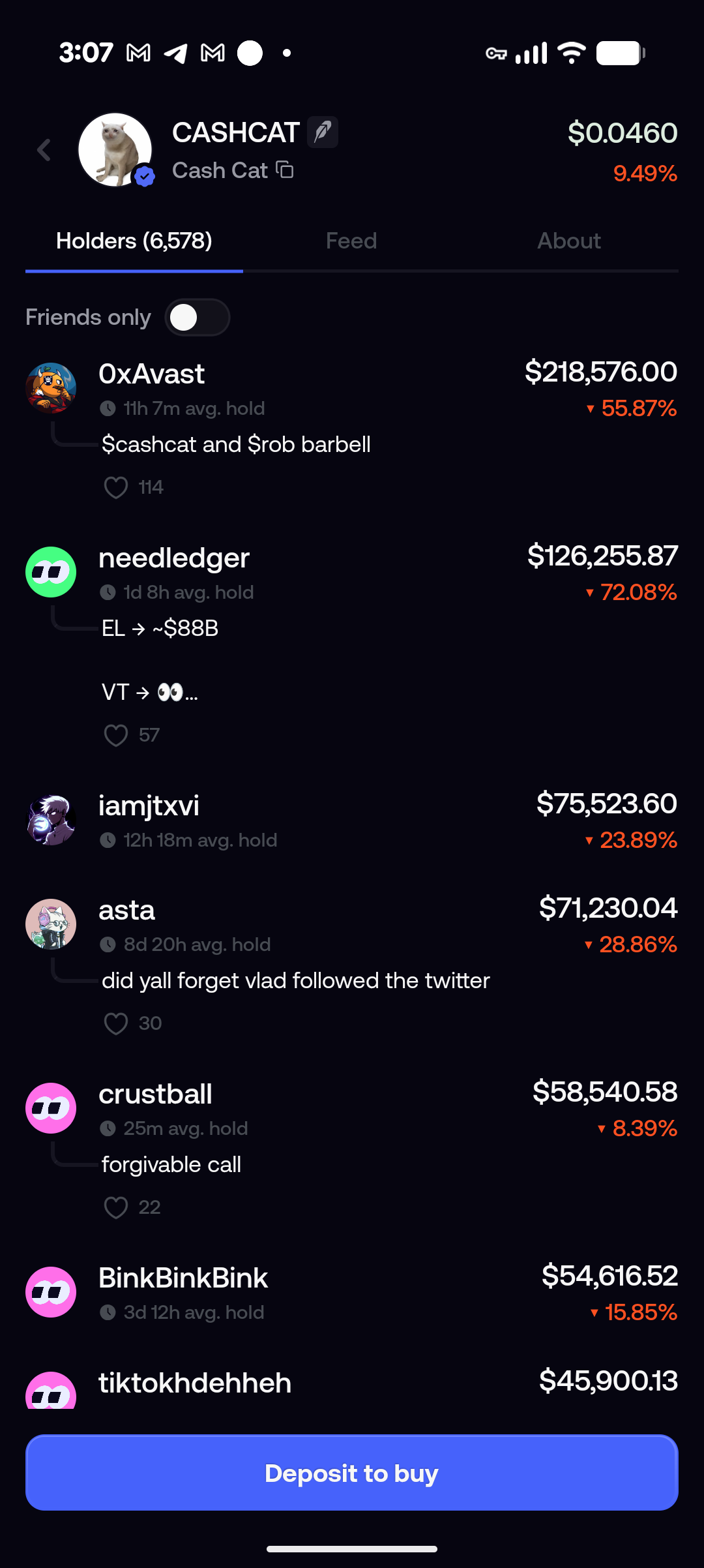
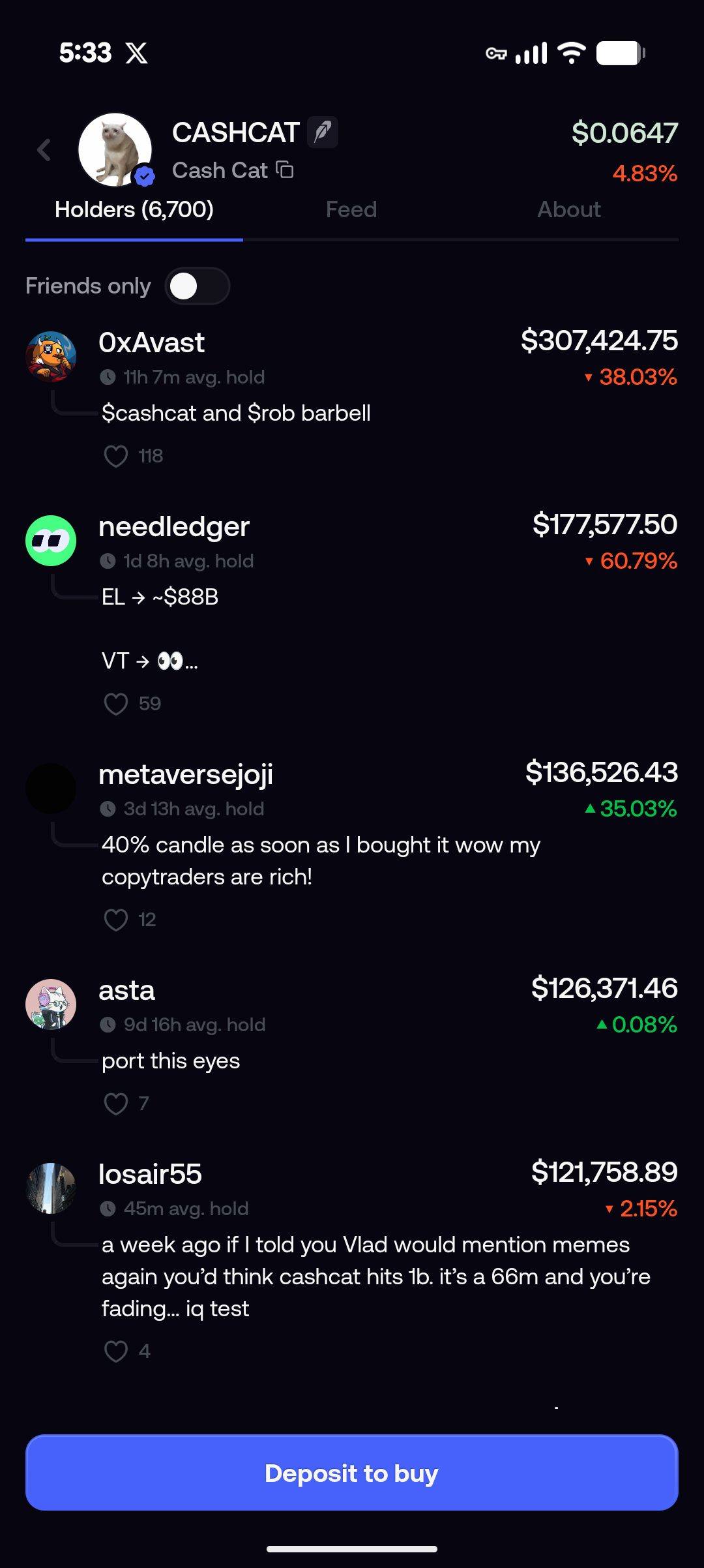
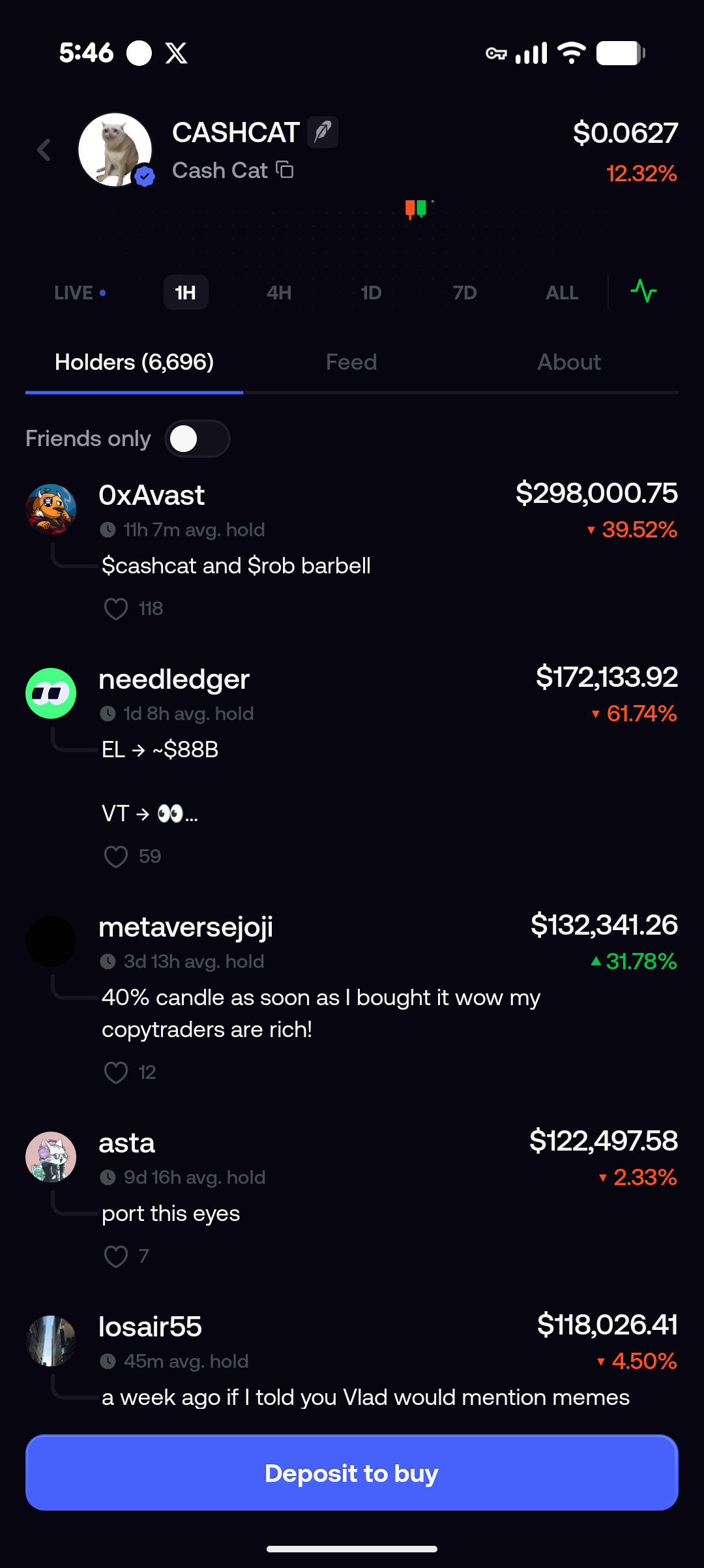
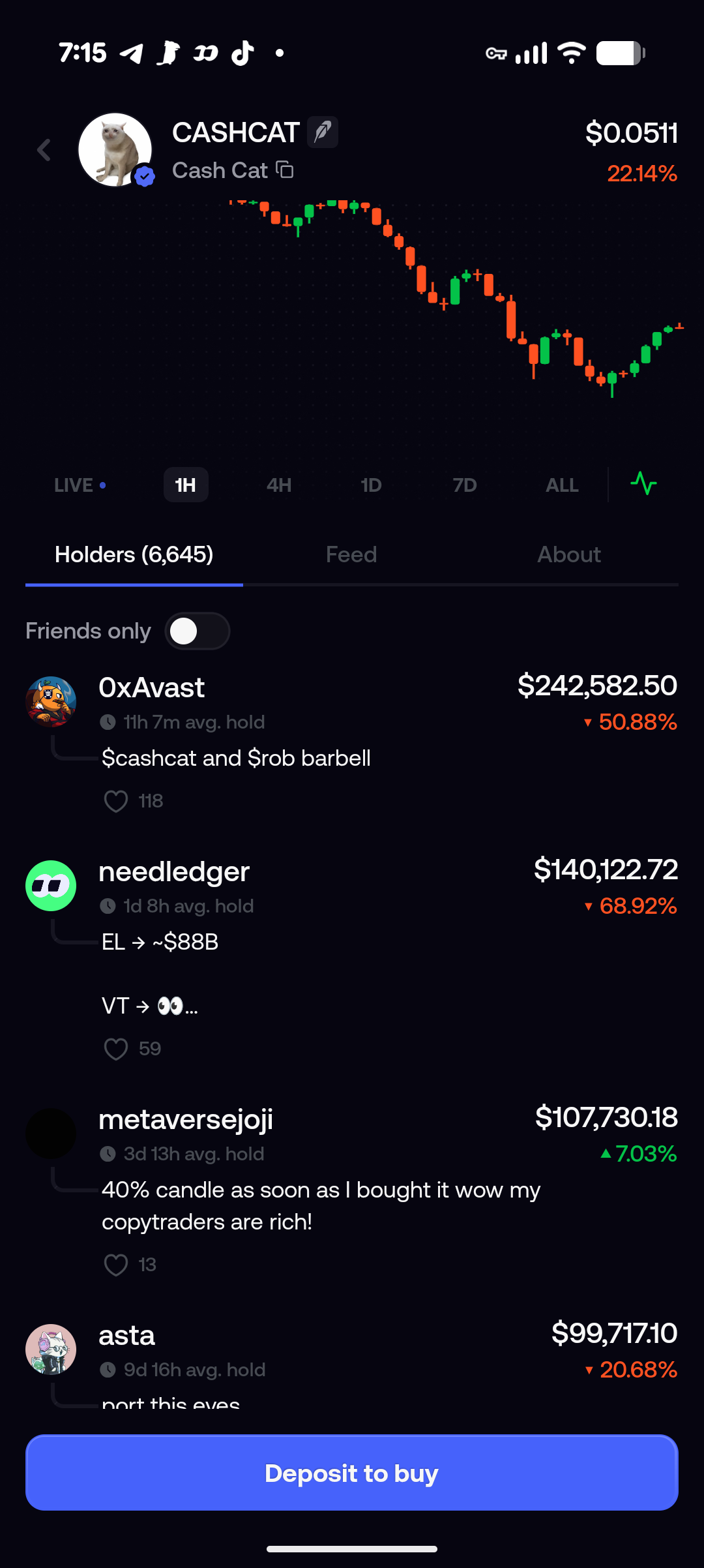
From 5:33 PM to 7:15 PM metaversejoji went from +35% to +7.03% — still posting "40% candle as soon as I bought it wow my copytraders are rich!" The caption didn't change. The position bled 33 percentage points. 0xAvast: -50.88% on $242,582. needledger: -68.92% on $140,122. 6,645 holders — down 55 from the peak. The window closed at 5:33 PM. The caption is a timestamp of the exact moment the trap closed.
metaversejoji posted "40% candle as soon as I bought it wow my copytraders are rich!" — entering after the re-injection pump. Their copytraders followed. 122 new people entered between 3:07 PM and 5:33 PM — during an active drain cycle — because the chart looked like recovery. The re-injection didn't just attract new buyers. It psychologically anchored existing holders deeper, turning -55% into -38% on paper and keeping them in the trap. The copytraders are now in too. The pool is still draining. LP still 0.0% locked.
With 6.1 WETH (~$23,000) in the pool, there is not enough liquidity for even a single top holder to exit their full position. needledger's displayed position of $126,000 would require $126,000 in buyers on the other side. The entire pool contained $23,000. These bags are not just underwater — they are structurally unredeemable at any meaningful size. The exit door was closed when the liquidity was pulled. The 30,000 holders just didn't know it yet.
By 10:18 PM the pool held 44.9947 WETH (~$81,000). 0xAvast alone shows $242,582 at -50.88%. The entire pool cannot cover half of one top holder's exit — and there are 6,645 others behind them. This is not illiquidity. This is a structural trap. The math was always impossible. The re-injection rebuilds the pool slowly — just enough to maintain price, not enough to provide meaningful exit liquidity.
"Contract source not verified — code is hidden." This isn't a minor footnote. An unlocked LP with verified code is dangerous. An unlocked LP with hidden code is a black box with an open drain. The contract could contain: sell taxes that scale with position size, wallet blacklisting, maximum sell limits, automatic LP drain triggers, or functions that lock large wallets out of selling entirely — conditions that only activate under specific circumstances. Retail will never know until they hit them. The deployer knows exactly what levers exist. Nobody else does. We can see the WETH moving. We cannot see what else is moving with it.
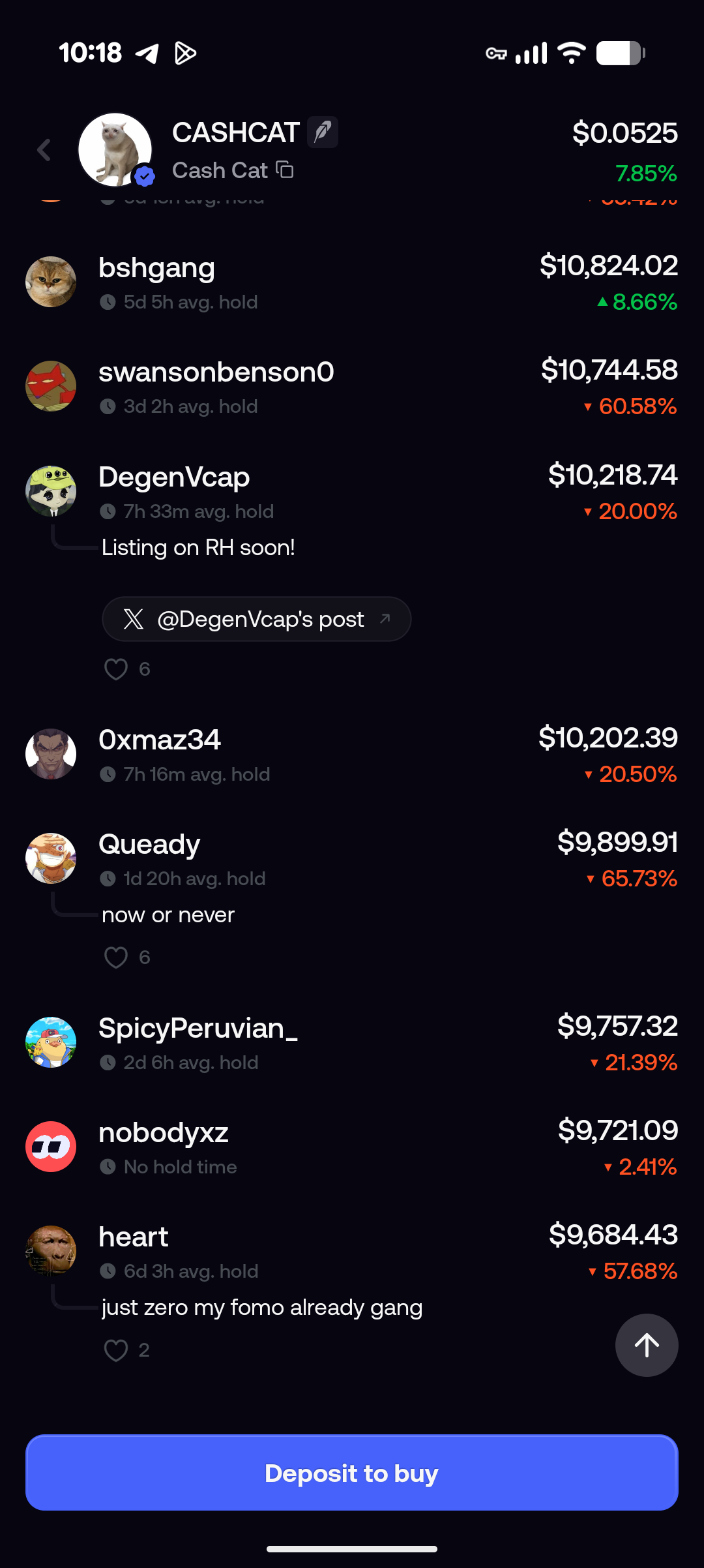
Six days. Three hours. -57.68% on $9,684. Through the first drain. Through the re-injection. Through the second drain. Through the weekend rebuild. Still there at 10:18 PM with one sentence that contains more self-awareness than anything else on the leaderboard: "just zero my fomo already gang."
He knows. He knows it's FOMO. He knows it's not rational. He's asking the community to help him let go of something he doesn't have the tools to let go of himself. The tools he needed were on-chain. They existed on July 13th at 8:59 AM. Nobody put them in front of him.
Above him: DegenVcap — -20% on $10,218 — still posting "Listing on RH soon!" Manufacturing hope for the people beneath him. The trap has layers. The trapped become the trappers without knowing it. That's who RPD is built for. Not the sharp traders. Not the whales. heart. The person who knows something is wrong but doesn't have the variable that makes the equation solvable.
While WETH was being systematically drained and re-injected — movements of 80–100 ETH at a time — the DexScreener chart held a suspiciously stable range. The price didn't collapse when the LP hit 6.1 WETH. It didn't spike when 206.5 WETH was re-injected. It traded sideways. That stability under massive LP movement is not normal market behavior. It is price management.
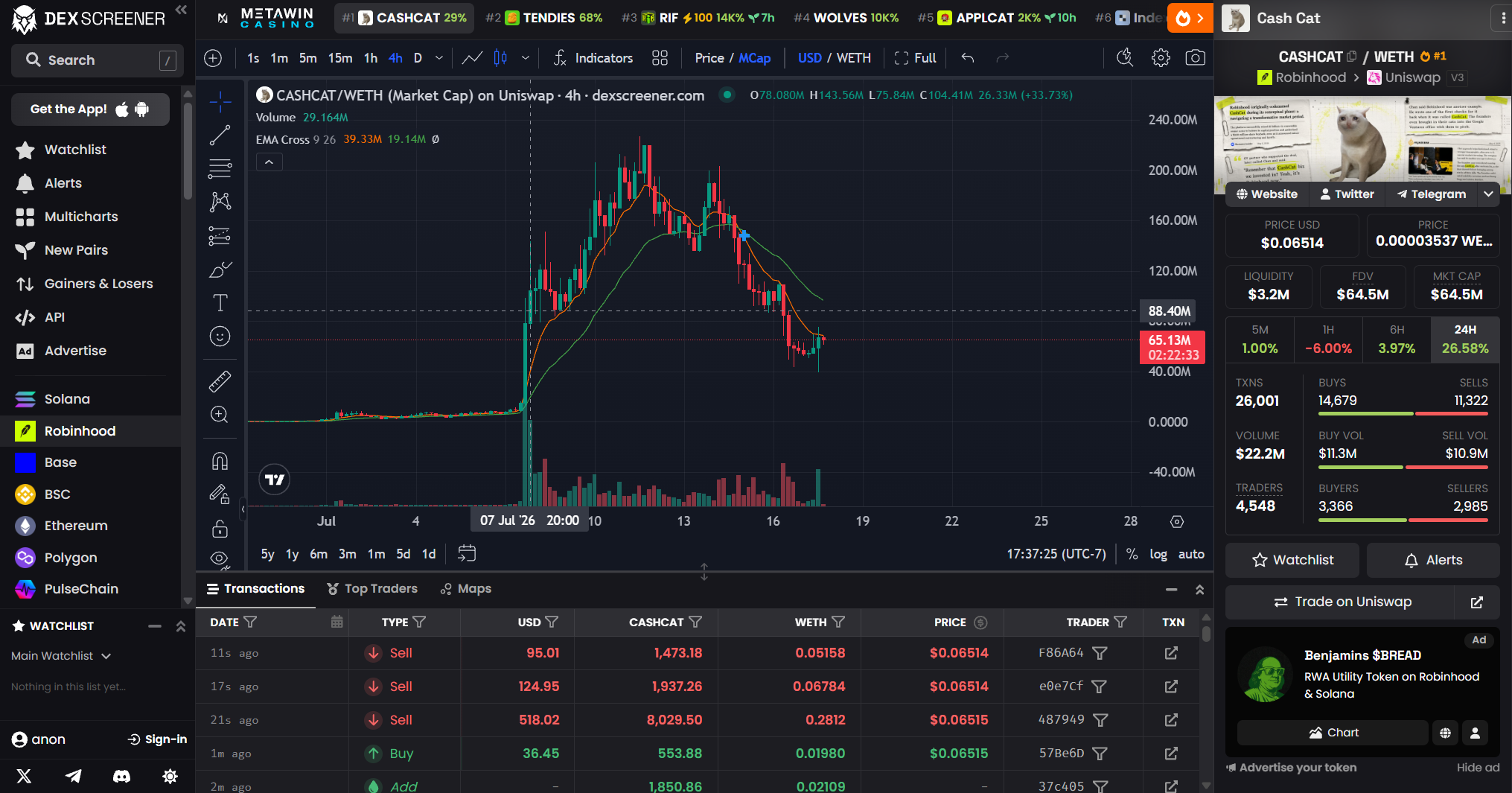
Price Stuck. WETH Moving. That's the Tell.
A legitimate liquidity event — even a large one — moves the price. Adding 100 WETH to a pool should pump it. Removing 88 WETH should crash it. Neither happened here at the expected magnitude. The chart stayed range-bound through every LP movement because the price was being managed to keep the chart looking healthy while the extraction continued underneath.
Note the transaction feed: sells of $518, $124, $95 — retail exiting in small amounts. One buy of $36. The volume is retail noise. The real movement is happening at the LP level, invisible to anyone not running a scanner.
WETH LP moving in and out at this scale while the chart holds a range is not trading. It is theater. The chart is the curtain. RPD reads what's behind it.
The 4H chart hides the mechanics. The 5-minute chart shows them naked. When the re-injection hits, it doesn't look like organic buying pressure accumulating over time. It looks like a single vertical candle at exactly 16:00 — dwarfing everything around it — followed by retail FOMO chasing a move they didn't understand, then a slow bleed back down as the pool empties again. No buildup. No consolidation. No technical pattern. A switch.
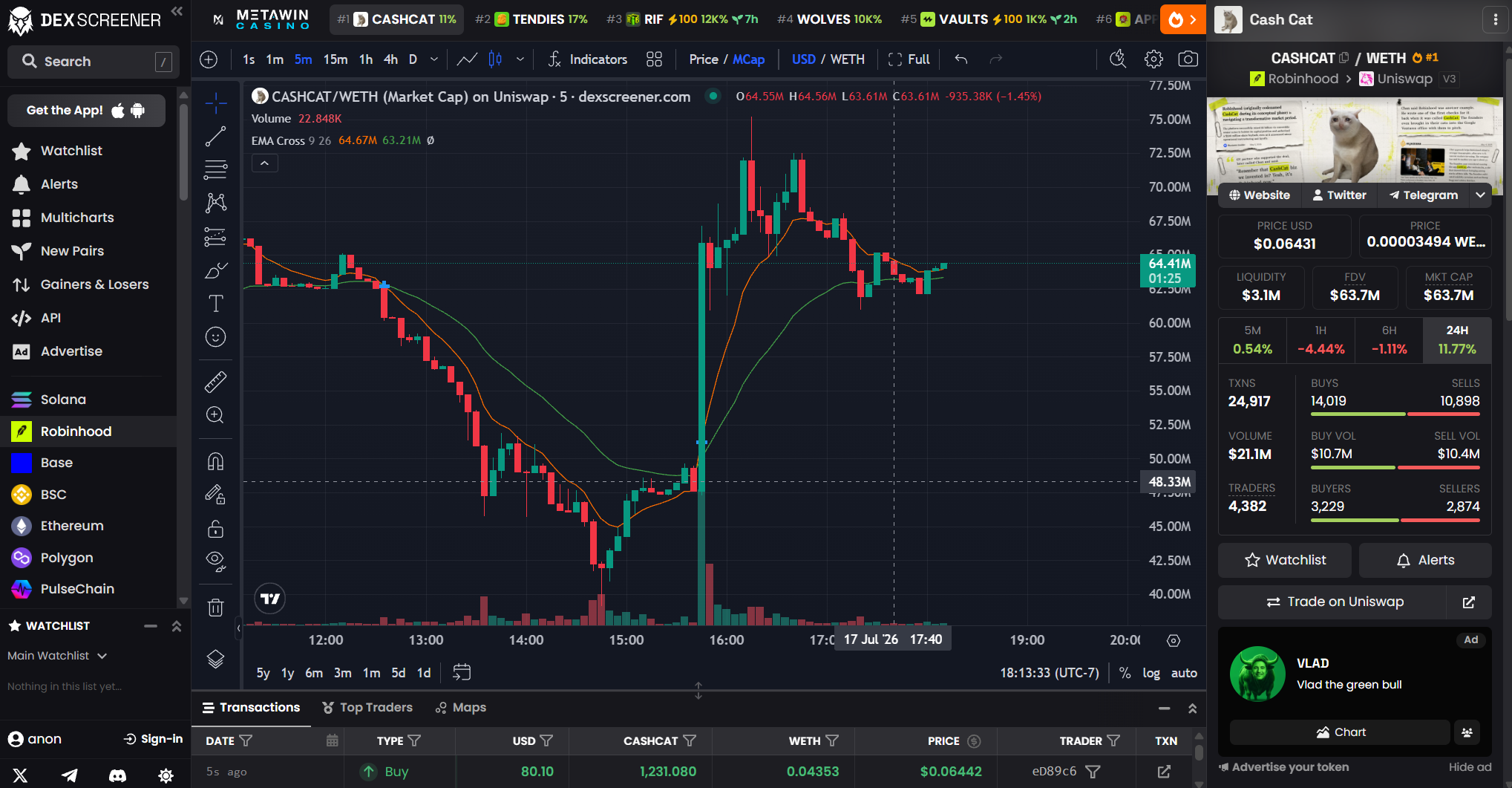
Organic Pumps Have Stairs. This Has a Cliff.
Real buying pressure builds. You see a series of green candles, increasing volume, momentum. Traders enter progressively as confidence builds. The move takes time because humans take time.
The 16:00 candle is a cliff, not a staircase. One massive green bar. Then retail scrambles in — chasing, not leading. Then the slow grind down as the pool drains underneath the chart. The candle shape is the confession. It doesn't move like a trade. It moves like a transaction.
Meanwhile the right panel tells the full picture: 24,917 transactions. 14,019 buys vs 10,898 sells. 3,229 buyers. 2,874 sellers. $10.7M buy volume vs $10.4M sell volume. Retail is net buying. The pool is net draining. The math only works if someone is extracting from the LP side — not the trade side. Invisible to buyers. Visible to RPD.
Hours after the pool reached 6.1 WETH, the deployer re-injected liquidity. Not the full 94.6 WETH that was originally there. A calculated amount: 88.8 WETH. Enough to restore the chart. Enough to look like survival. Not enough to fully return what was taken.
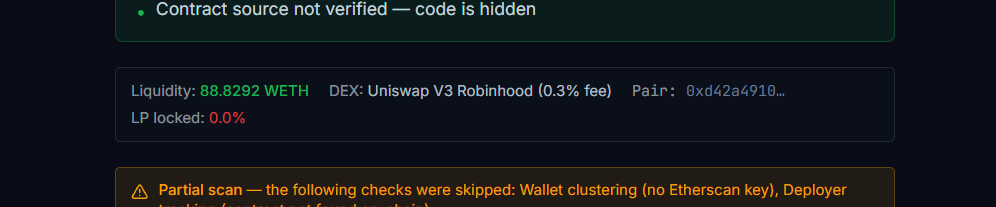
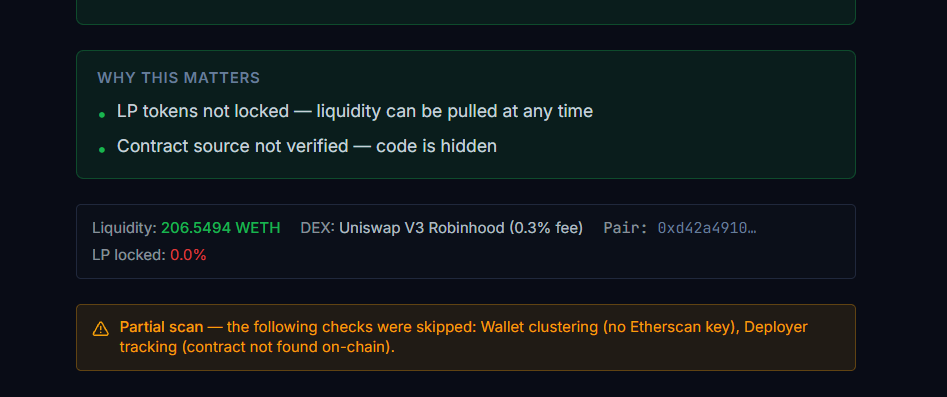
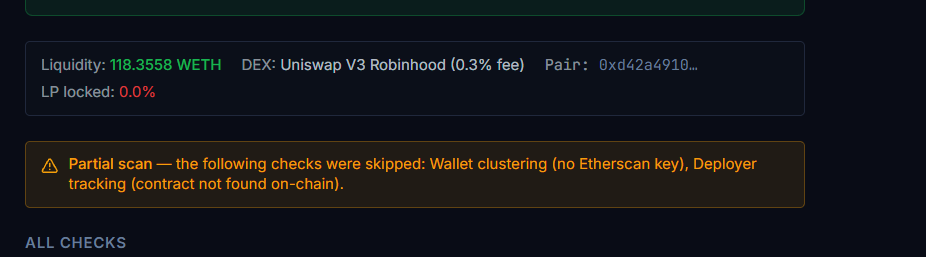
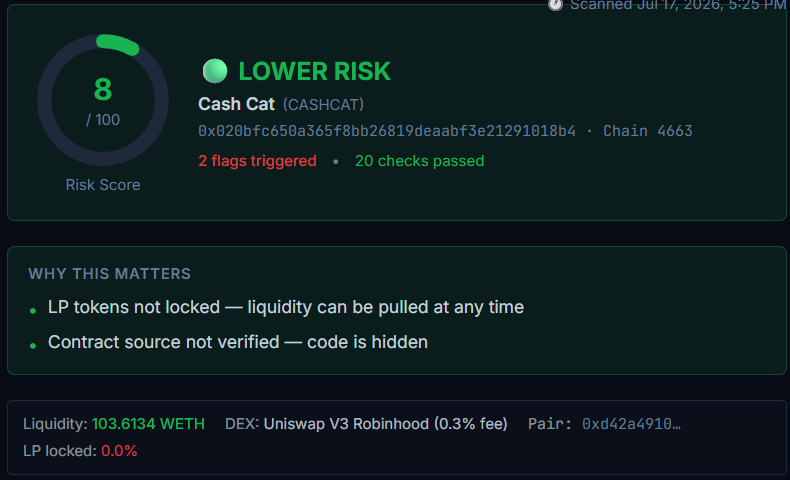
Pool refilled to 206.5 WETH — more than double the original. Second drain began immediately. 103.6 WETH remaining as of 5:25 PM scan. Over 100 WETH extracted in cycle 2 already. Risk score: 8/100. Same 2 flags. Score unchanged because the flags never changed. The deployer is running the identical playbook on a fresh wave of buyers who saw "recovery" and entered. LP still 0.0% locked. Contract still hidden. This is a confirmed, ongoing, self-funding extraction cycle.
They Pulled Out a Calculator
A legitimate developer has exactly one reason to touch the liquidity pool — and it's locking it from the start. Every other action requires a story. Here is what each story looks like when examined:
"Technical issue / mistake" — You don't accidentally drain 88 ETH over four hours in a graduated progression. Mistakes are sudden. This was surgical.
"Rebalancing" — Rebalancing to what? 88 WETH instead of 94? You retain 6 ETH for "rebalancing?" That is not rebalancing. That is a withdrawal with a cover story.
"They panicked and put it back" — Then put it all back. Every wei. Lock it immediately. Issue a public statement. Anything less is resetting the trap, not correcting a mistake.
The partial re-injection is the most incriminating detail in the entire event. It is the signature of calculated intent. Enough liquidity to restore the price chart. Enough to look like survival. Not enough to fully return what was taken. The deployer retained approximately 6 WETH — roughly $23,000 — extracted from 30,000 retail holders.
-
Phase 1
Launch with no liquidity pool
Hype builds. Community forms. FOMO app engagement grows. July 13, 8:59 AM — RPD fires first CRITICAL alert. -
Phase 2
Add liquidity pool — unlocked
Trading begins. Price pumps. FOMO buyers flood in. RPD fires second alert 51 minutes later: "LP not locked. Can be pulled at any time." -
Phase 3
Pump to $240M market cap (Days 1–4)
Community deepens conviction. Diamond hands culture activates. 30,000+ holders accumulate. Deployer quietly accumulates exit timing. -
Phase 4
Drain the pool gradually (July 17)
94.6 → 69.8 → 8.4 → 6.1 WETH over hours. Price craters. Panic sellers dump bags at the bottom for nearly nothing. -
Phase 5 ▶
Re-inject partial liquidity — reset the trap
6.1 → 88.8 WETH. Chart shows recovery. "It survived." New buyers enter. LP still 0.0% locked. Source still hidden. The door reopens.
RPD Said It at 8:59 AM on July 13th
Before the liquidity pool existed. Before the pump. Before the losses. The engine read the contract, checked the on-chain state, and reported exactly what was there: a hidden contract, no locked liquidity, and a structural condition that enabled everything that followed.
Two Telegram alerts. Same morning. Same $10/month subscription. The second alert said, in plain language: "Lets the dev pull all the trading liquidity out instantly, crashing the price to zero." That sentence described — with precision — what happened four days later.
This is not prediction. RPD does not predict. This is reading what the contract says before the market figures it out. The multi-phase drain, the partial re-injection, the calculated extraction — none of it required insider knowledge. It required one scan. One morning. Ten dollars a month.
In traditional markets, the documented behavior — graduated drain, coordinated refill to catch bounce buyers, second drain cycle — constitutes textbook market manipulation. In crypto, the DOJ and CFTC have successfully prosecuted this exact pattern under wire fraud (18 U.S.C. § 1343) and commodities manipulation statutes. The hidden source code strengthens the case for concealment with intent. The graduated drain schedule — not accidental, not sudden — demonstrates premeditation. The partial re-injection demonstrates a second act of calculated extraction.
RPD's timestamped forensic record — from the 8:59 AM first alert through every liquidity data point — is precisely the kind of sequential evidence a prosecutor, the CFTC, or a congressional hearing would require to establish the timeline of a manipulation event.
Important Notice: This case study is provided for educational and forensic documentation purposes only. The data presented reflects RPD's automated on-chain scans at the timestamps noted. Rugpull Defender makes no claim that any specific individual has committed fraud — structural flags reflect on-chain conditions that create risk, not confirmed intent. This is not financial or legal advice. All on-chain data is publicly verifiable. Always conduct independent research before trading any crypto asset.

🛡️ Don't Be the Next CASHCAT Story
$CASHCAT was flagged at 8:59 AM on July 13th. Before the pump. Before the losses. Before the drain.
Run the same analysis on any token across 10+ chains. The data is on-chain. We just read it before the market does.
© 2026 Rugpull Defender LLC · Mesa, Arizona